
I never intended to become a web designer/developer.
It wasn’t up there with childhood dreams of becoming a veterinarian, doctor, marine biologist or even a graphic designer.
While witnessing the evolution of the internet from the early 2000s onwards, I didn’t even consider that this could be someone’s profession.
I was aware of disciplines such as coding, software development, and cybersecurity, but it didn’t occur to me that a separate career existed in the design and development of websites. That behind every user-friendly, accessible and even visually appealing website, there was a designer/developer.
In my last blog post, I wrote about my journey from traditional art to digital design. You can read more about that here. You might recall that I mentioned time spent looking at designers, whose niches ranged from brand design to graphic and web design, and being inspired by their processes and craft via YouTube and Instagram.
While this did inspire me to design a couple of websites along the way for practice, I still didn’t know much about the front-end development process behind building a website, i.e. everything you see when you visit a website, such as buttons, media files, and links. There are also important factors such as obtaining a domain, hosting, servers, and maintenance, just to name a few. These are all important to keeping your website up and running.
I asked myself, what good is a well designed website if I couldn’t bring it to life?
Therein lies the next phase of my journey.
Initially, I knew that I wanted to create a portfolio website in order to display the design work I’d done thus far. So, I decided to try using a website builder platform. There are so many on the market nowadays, all marketing themselves as being “quick and easy to use” with “drag and drop” functionalities. But as it turns out, it wasn’t as easy as I thought. I found myself spending more time trying to figure out the purpose of each element and how best to put them together to create a cohesive website.
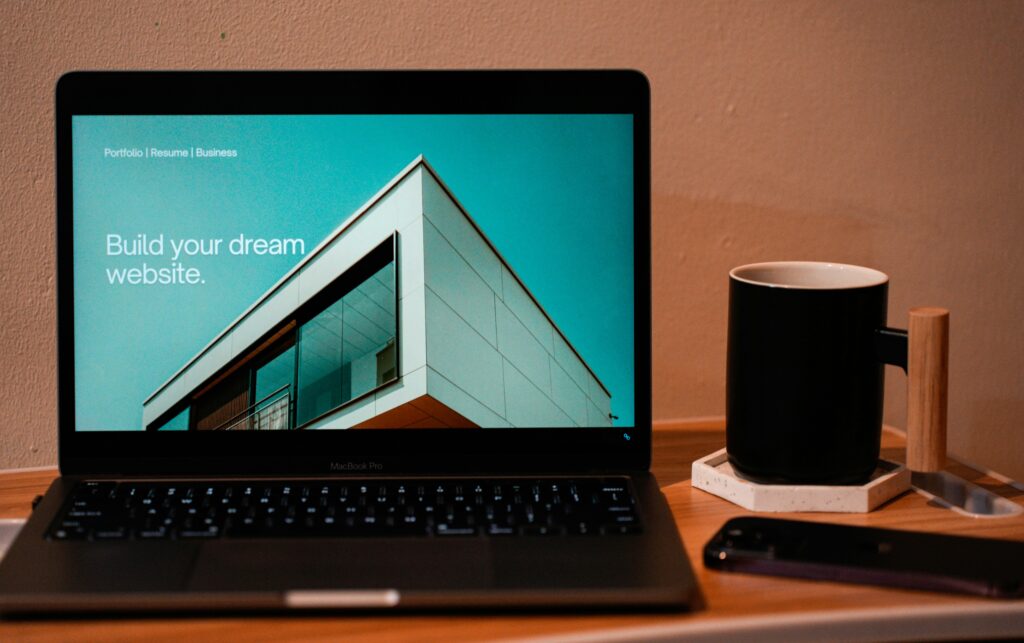
After a few attempts on different platforms and less than satisfactory results, I realised that this path wasn’t working out like I had hoped. I decided that I wanted to better understand the process behind building a functional website and felt like a foundation in HTML and CSS was the best place to start.
So I signed up for an online web development course with a local college and started learning the basics. Through the assignments I tackled and my own research, I began to better understand how these two languages worked together to form the basis of all web pages on the internet. When it was eventually time to code my own portfolio website as part of my final project, I accepted the challenge with open arms. However, as a beginner, it wasn’t necessarily a walk in the park. It involved writing meticulous lines of code, constantly testing my changes, and debugging errors. But, in the end, I made it.
I’d hand coded a website of my own. It was very basic in hindsight, but I was extremely proud of my efforts. Once my project had been approved by my tutor and I was a certified novice web developer, I wondered what was next. I now had the fruits of all my labour on my hard drive: files of code. But it wasn’t enough to let it sit there and collect virtual dust.
I still needed a functional portfolio website to display my work and I figured this could do the trick.
After some research, I decided to go with Hostinger as my website hosting platform combined with WordPress as my content management system (CMS). I uploaded my files and there it was. My very own portfolio website. Not only was I now able to design a website, I could build one too. And that outcome was born out of sheer need.
Before that point, even though I was inspired to become a web designer and developer, I had no academic experience or clients to get me started. I even had several attempts at learning HTML and CSS under my belt from online coding academies but never made it far enough to produce a working website.
So what am I trying to say with all of this?
I’m saying that you shouldn’t wait until clients or opportunities come your way in order to begin.
Start exactly where you are. Create the work that you want and need for yourself first. Be selfish, hone your skills, and then share it with those around you. You might be surprised at where it can take you.
Now start creating and I’ll catch you in the next one!
Until then,
Naomi